


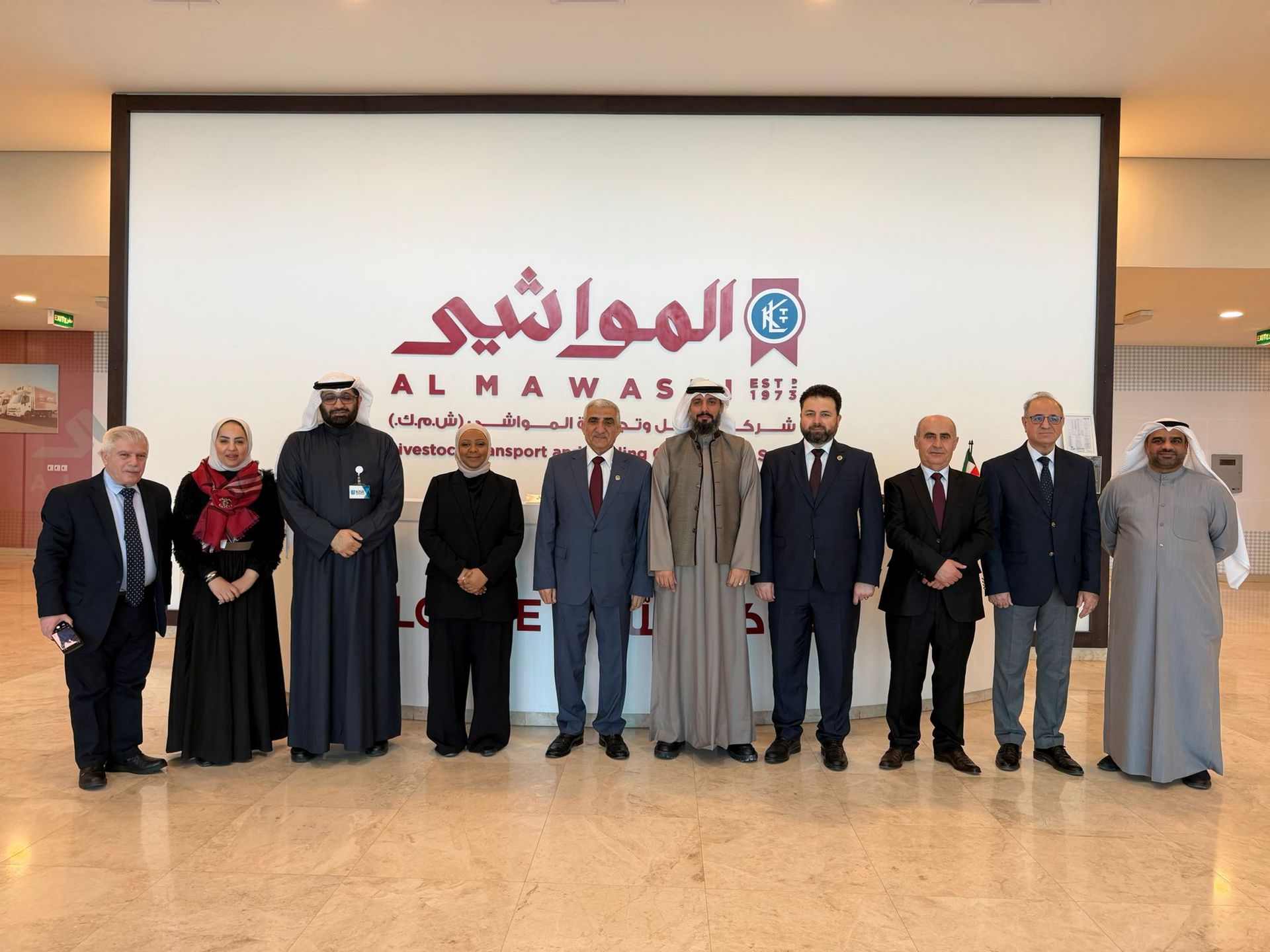
A delegation from the Arab Center for the Studies of Arid Zones and Dry Lands (ACSAD), headed by Dr. Nasr Al-Din Al-Obeid, the organization’s Director General, participated in a field visit to the State of Kuwait to strengthen cooperation initiatives with leading Kuwaiti and Arab institutions. This visit took place on the sidelines of the 16th International Inventions Exhibition 2025, organized by the Kuwaiti Scientific Club.
The visit focused on enhancing cooperation in the fields of food security and sustainable agricultural development. It included signing partnership agreements with Arab companies and institutions to support livestock productivity, increase meat and dairy production from sheep, goats, and camels, and expand the application of vertical farming techniques for leafy vegetable production.
Dr. Al-Obeid explained that the delegation toured the facilities of the Kuwaiti company Al-Mawashi, including compost production laboratories and vertical hydroponic farming systems. During the visit, agreements were reached to cooperate on improving milk and meat production, developing animal feed, managing livestock pens, enhancing veterinary services, and providing the company with improved sheep and goat breeds from ACSAD’s research stations.
It was also agreed to leverage ACSAD’s expertise in managing salinity-affected lands, cultivating salt-tolerant forage crops, and promoting the planting of high-nutritional-value smooth cactus, with a memorandum of understanding (MoU) planned to implement these projects.
In a separate meeting with Walid Shumlan Al-Bahr, Acting Director General of the Kuwait Fund for Arab Economic Development, Dr. Al-Obeid presented the key environmental projects ACSAD is implementing or planning in Kuwait, including combating desertification through biological stabilization of sand dunes, rehabilitating degraded natural pastures, and improving their productive efficiency. The Director General of the Fund emphasized the importance of these projects and the need to study their financing in cooperation with the Public Authority for Agriculture and Fisheries Affairs.
Additionally, an MoU was signed with the Kuwait Institute for Scientific Research (KISR) for scientific and technical cooperation, in the presence of KISR Director Dr. Faisal Salman Al-Humaidan. The MoU focuses on improving livestock production from ruminants, poultry, camels, and fish; localizing improved varieties of drought- and salinity-tolerant cereal crops; cultivating fruit trees adapted to arid environments; integrated management of water and agricultural land resources; applying climate-smart agricultural technologies; combating desertification; conducting joint regional applied research; implementing training programs; and exchanging experts and genetic resources.
Dr. Al-Obeid noted that this visit represents a practical step to enhance Arab cooperation in applied scientific research and sustainable agricultural development, aiming to address shared challenges such as water scarcity, food deficits, and climate change, and to work toward achieving food and water security in the Arab region.